
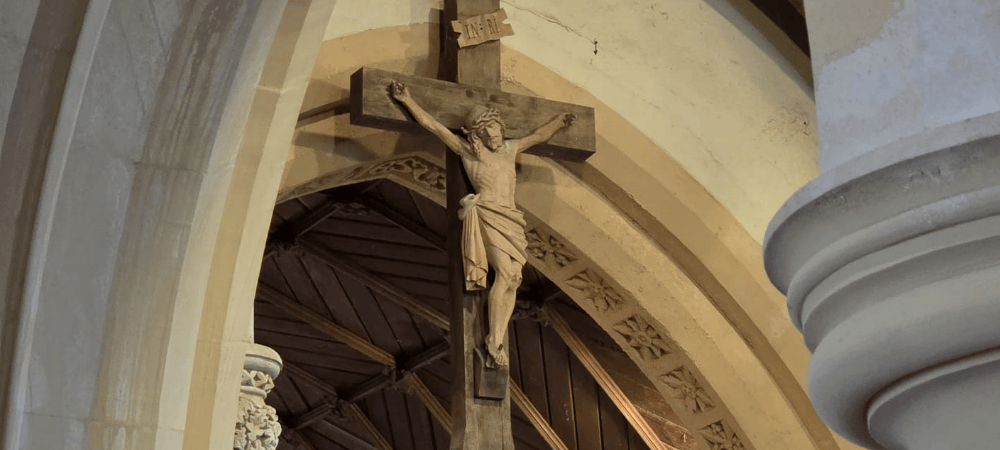
“Jesus Christ is the same yesterday and today and for ever.”
Letter from St Paul to the Hebrews 13:8
Standing on the hillside above the waters of the Daugleddau, St Michael and All Angels has watched over Cosheston for centuries.
Long before there were cars on the road to Pembroke, before the construction of the dockyard at Pembroke Dock, before the Industrial Revolution reshaped Britain, Christians were gathering on this site to pray, worship and celebrate the milestones of life. The church we see today has its roots in the medieval period and is first recorded in 1291, although parts of the building may be older still.
To understand the story of St Michael and All Angels, however, we need to look beyond the walls of the church itself and imagine the world in which it first came into being.
A Church in Medieval Wales
The thirteenth century was a time of enormous change. Across Britain, magnificent cathedrals and parish churches were being built, while communities organised themselves around the rhythms of the Church year. For most people, the parish church was the heart of daily life. It was where children were baptised, couples married, and loved ones laid to rest. It was where news was shared, disputes settled and communities gathered.
Cosheston itself occupied an enviable position overlooking one of the many inlets of the Milford Haven waterway. The Daugleddau was not merely a beautiful landscape feature. It was one of the great highways of medieval Wales, connecting local communities to wider trade networks and bringing prosperity to the area. Archaeologists believe that St Michael and All Angels stood within what was once a planned medieval settlement. Church and village grew together. For centuries the lives of local families would have revolved around this place, just as the church’s life revolved around the community it served.
Beneath the Patronage of St Michael
The church was dedicated to St Michael and All Angels, a dedication found throughout Britain and Europe. In Christian tradition, St Michael is the great archangel who remains faithful to God and stands against evil. Medieval people often saw Michael as a symbol of courage, protection and hope. Many churches were placed under his patronage, especially in prominent locations overlooking the surrounding landscape. For the people of medieval Cosheston, the church would have been a visible reminder that God was present amidst the uncertainties of life, whether those uncertainties came through illness, poor harvests, political upheaval or personal loss.
Reformation and Change
The sixteenth century brought profound change to Britain. The Reformation transformed the religious life of the nation. Services gradually began to be conducted in English rather than Latin, the Bible became more widely available, and the Church developed into what would eventually become Anglicanism.
St Michael and All Angels remained at the centre of village life throughout these upheavals. Generations came and went, kingdoms rose and fell, yet the church continued to gather people for worship week by week. The church that survives today still contains elements dating from this period, including parts of the tower and north aisle which were added in the early sixteenth century.
The Age of Estates and Gentry
As the centuries passed, local landowners became closely connected to the life of the parish. Families associated with nearby estates such as Cosheston Hall, Paskeston Hall, and the wider Upton area would have played important roles in supporting both church and community life. The story of Cosheston has never been solely a church story. It is also the story of farmers, labourers, craftsmen, servants, sailors and families who built their lives in this corner of Pembrokeshire. The church was where all these stories came together. By the nineteenth century, figures such as Sir John Owen held the patronage of the parish, demonstrating the close relationship that often existed between local churches and the leading families of the area.
Victorian Renewal and the Oxford Movement
Much of what visitors admire today owes its appearance to the Victorian period. The nineteenth century witnessed a remarkable revival of interest in church buildings throughout Britain. Within the Church, a movement known as the Oxford Movement encouraged Christians to rediscover the beauty, history and spirituality of the ancient Church. Across Wales and England, churches were carefully restored, repaired and renewed. St Michael and All Angels was no exception. Repairs took place in 1831, but a much more extensive restoration followed in 1885. Victorian architects sought to recover the beauty of medieval worship, introducing Gothic details, new furnishings and a renewed sense of dignity to parish churches.
Many of the features seen today date from this period. Far from trying to create something entirely new, the Victorians were attempting to honour the church’s medieval past and ensure that it could continue serving future generations. The wood carvings of local craftsman John Mathias are among the treasures of this restoration period and remain a distinctive part of the church’s character.
A Community Through Modern Times
The twentieth century brought its own challenges and opportunities. Two world wars touched the lives of local families. Agriculture changed. Industry developed around Milford Haven and Pembroke Dock. New housing and transport transformed the way communities lived and worked. The church adapted alongside these changes. In 1980 the stone spire that had once crowned the tower was removed because of structural concerns, altering a familiar landmark that had been visible across the surrounding countryside for generations.
Yet despite changing times, the church remained what it had always been: a place where people came to mark the important moments of life and seek the presence of God.
The Story Continues
Perhaps the most remarkable thing about St Michael and All Angels is not its age, but its continuity. For at least seven centuries, people have walked through these doors carrying the same hopes, fears, questions and joys that we carry today. Children have been baptised here. Couples have exchanged vows here. Families have gathered here to say goodbye to loved ones. Countless prayers have been whispered beneath this roof. Empires have risen and fallen. Monarchs have come and gone. Wars have been fought. Technology has transformed the world.
Yet through all of this, Christian prayer has continued on this hillside overlooking the Daugleddau. Today, we are simply the latest chapter in that story.
Whether you are a lifelong worshipper, a visitor passing through, exploring faith for the first time, or returning after many years away, you are invited to become part of the continuing story of St Michael and All Angels, Cosheston.

